
A&I Insights
How to Build an Interoperable EHR for Real-Time Healthcare Data Exchange
As healthcare organizations expand across multiple locations, one challenge becomes unavoidable—how do you ensure every clinic stays connected, consistent, and scalable without breaking workflows? Most EHR systems claim to support multi-…
Published
As healthcare organizations expand across multiple locations, one challenge becomes unavoidable—how do you ensure every clinic stays connected, consistent, and scalable without breaking workflows?
Most EHR systems claim to support multi-location use, but in reality, they struggle when scaled. Data becomes fragmented, workflows differ across clinics, and real-time coordination breaks down. That’s why, even when systems exchange data, it often lacks structure, context, and usability inside clinical workflows.
That’s why having a scalable multi-clinic EHR deployment strategy is critical in 2026.
Scaling an EHR across multiple clinics isn’t just about replication—it’s about designing systems that support real-time data exchange, standardized workflows, and consistent access across locations.
A strong approach to enterprise EHR scaling ensures that every clinic operates on the same foundation while still allowing flexibility for local needs. At the same time, a well-defined multi-location EHR deployment plan ensures smooth rollout, minimal disruption, and long-term scalability.
In this guide, we’ll break down how to design and deploy an EHR system that scales seamlessly across clinics while maintaining interoperability, performance, and care coordination.
Why Is Interoperability Critical for Connected Healthcare?
An EHR is interoperable when it can securely exchange standardized healthcare data that other systems can accurately interpret and use within clinical workflows.
When it comes to EHR interoperability, it is often understood as the ability to exchange data between systems. While this is true on the surface, true interoperability means that data flows accurately, consistently, and meaningfully across systems.
At a foundation level, interoperability depends on systems being technically capable of exchanging data. Moreover, structural interoperability ensures that clinical data is standardized so each system can process it reliably. However, the real challenge is creating semantic interoperability and making sure that data carries the same context across systems.
Without this semantic consistency, the clinical data may arrive on time, but it will lack meaning and structure, and it can’t be safely used or interpreted. That’s why EHR interoperability standards and data standardization are crucial for workflow-ready information exchange.
In short, EHR interoperability is not just about connectivity. It’s about ensuring that exchanged data is meaningful and ready to support coordinated and real-time care across providers, patients, and payers.
Core Interoperability Standards: HL7, FHIR & USCDI
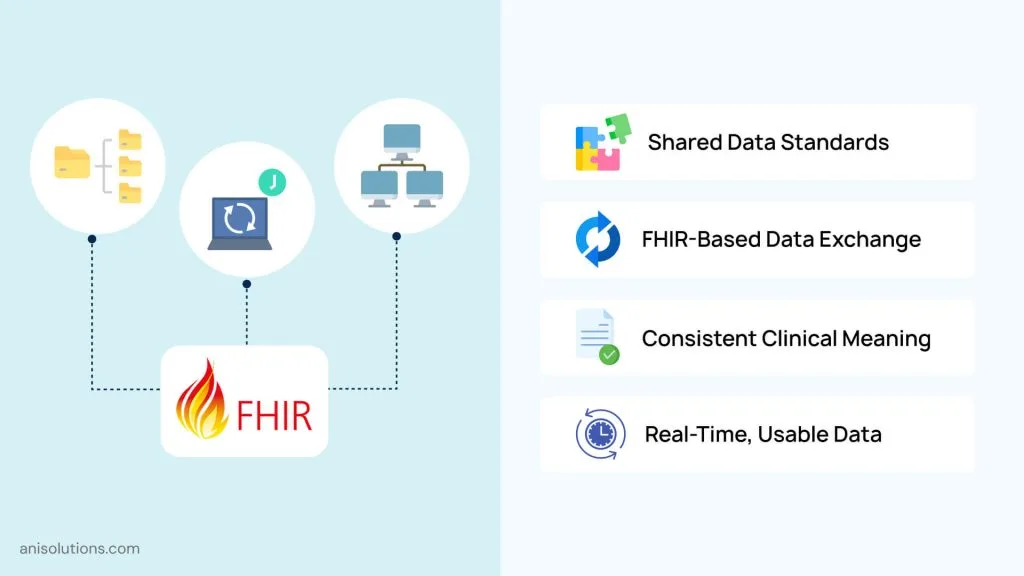
Interoperability relies on standardized frameworks that allow healthcare systems to exchange, interpret, and use clinical data consistently across organizations. The most widely adopted interoperability standards include:
- HL7 v2 – Supports real-time messaging for clinical events such as admissions, laboratory results, and orders.
- FHIR R4 – Enables standardized API-based exchange of structured healthcare data across modern applications.
- USCDI (United States Core Data for Interoperability) – Defines the core clinical data classes and elements that healthcare organizations should exchange consistently.
Together, these standards provide the technical foundation for building interoperable EHR systems that support real-time care coordination and scalable data exchange.
If you’re looking for a detailed explanation of FHIR architecture, resources, compliance requirements, and implementation best practices, read our complete guide to FHIR Compliance & Interoperability for EHR Systems.
Interoperable EHR Readiness Checklist (Real-Time Care & FHIR-Based Exchange)
Get NowDesigning an EHR for Real-Time Data Exchange
Now that we have understood what interoperability is and the core standards required to enable interoperability. With this, it will become easy to understand how to design an EHR for seamless data exchange. Seamless data exchange happens when interoperability is considered the core system capability, not as an extension after building the EHR.
The first step in designing is exchange-ready data modeling. EHR data must be structured from the outset to support standardized representation and reuse. Meaning, aligning internal data models with healthcare data exchange standards so information can move across systems without constant transformation or manual intervention.
Next, interoperable EHRs must support real-time and event-driven data exchange. Modern care delivery depends on timely updates from lab results, medication changes, care plan updates, and referral status, which cannot wait for batch exports or delayed synchronization. Designing EHR workflows around real-time triggers ensures that relevant data is shared and consumed at the moment it becomes clinically meaningful.
Another critical design principle is avoiding data silos within the EHR itself. Even when external integrations exist, poor internal data separation can limit interoperability. Clinical, administrative, and financial data should be designed to interoperate through shared standards and identifiers, enabling consistent data exchange across care teams, patients, and payers.
Finally, APIs should support standardized interoperability patterns so clinical information can move predictably between systems. Many modern EHRs use FHIR APIs to accomplish this, but implementing FHIR effectively involves additional design and compliance considerations covered in our dedicated FHIR Compliance guide.
| Design Area | What It Enables | Why It Matters for Interoperability |
| Exchange-ready data models | Standardized representation of clinical data | Reduces transformation errors and ensures consistency across systems |
| FHIR-based data structures | Modular, reusable clinical data exchange | Enables real-time, workflow-safe interoperability |
| Event-driven data sharing | Immediate propagation of clinical updates | Supports timely decision-making and care coordination |
| Standardized exchange patterns | Predictable data behavior across integrations | Prevents fragmented or inconsistent data interpretation |
| Workflow-integrated interoperability | Data appears where clinicians need it | Ensures exchanged data is usable, not just available |
In short, by embedding interoperability into data models, workflows, and exchange logic, healthcare organizations can move beyond basic connectivity and build EHRs that support continuous, real-time care coordination.
Preparing Your EHR for Interoperability in 2026
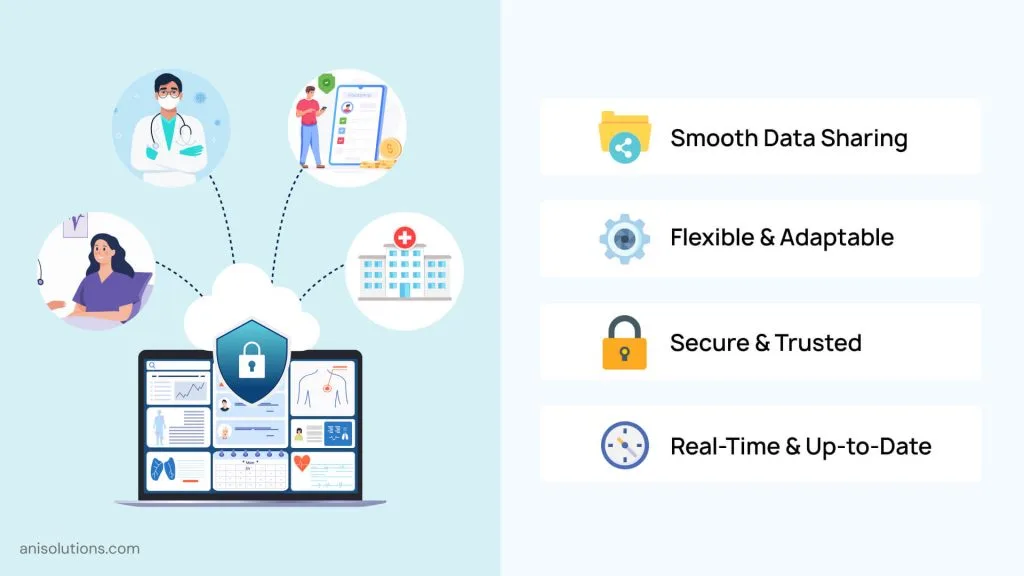
As said in the introduction, 2026 is no longer defined by one-time integrations or static data exchange. EHRs must be designed to support continuous, evolving interoperability requirements driven by patients, providers, payers, and regulators. Preparing for this reality means treating interoperability as an ongoing capability rather than a finished milestone.
One of the most important expectations in 2026 is multi-stakeholder data access. Patients expect timely access to their health information, providers require complete longitudinal records, and payers need standardized data to support care coordination and value-based reimbursement. EHRs must enable secure, role-appropriate data exchange across these stakeholders without fragmenting clinical workflows.
Another critical consideration is alignment with CMS interoperability expectations. Rather than approaching CMS requirements as compliance tasks, interoperable EHRs should be designed to naturally support standardized data exchange, patient access, and information sharing mandates.
When interoperability standards are embedded into the system’s foundation, meeting CMS expectations becomes an outcome of good design, not a reactive effort. Adaptability is equally important as healthcare data exchange standards, interoperability frameworks, and care delivery models will continue to evolve beyond 2026.
Standardized data models and modern interoperability standards provide the flexibility needed to support future healthcare technologies and regulatory requirements. For organizations implementing FHIR specifically, see our dedicated FHIR Compliance guide.
Ultimately, preparing EHRs for 2026 means ensuring that interoperability supports real-world care delivery at scale. Systems must handle growing data volumes, increasing exchange frequency, and expanding interoperability use cases, while maintaining data integrity, performance, and clinical usability.
To understand how architectural layers, APIs, and data models make this level of adaptability possible, read our Complete Guide to Understanding EHR Software Architecture.
Your Guide to Real-Time EHR Interoperability Architect
Click HereFinal Take: Building a Truly Interoperable EHR
In a nutshell, interoperability is no longer an optional enhancement for EHR systems; it is a core capability that must be intentionally designed. EHRs built without standardized data exchange struggle to support real-time care coordination and evolving interoperability demands.
By embedding EHR interoperability standards, adopting FHIR-based EHR integration, and enforcing consistent data standardization, ensures that exchanged standards and regulatory expectations continue to evolve.
With this, EHRs are designed for interoperability to remain scalable, adaptable, and future-ready. So, if you want to develop an interoperable system that grows with you, click here to book a demo and get started.
Frequently Asked Questions
A fully interoperable EHR can exchange data across systems and ensure that incoming information is structured, standardized, and usable within clinical workflows—without manual reconciliation or loss of meaning.
Interoperability enables clinicians to access complete, up-to-date patient information in real time, reducing delays, duplicate tests, and errors while supporting coordinated decision-making across care teams and settings.
Modern EHRs rely on healthcare data exchange standards that support structured data, consistent terminology, and scalable exchange—ensuring information can move reliably across providers, payers, and patient-facing systems.
Semantic interoperability requires data to retain the same clinical meaning across systems. Differences in terminology, coding, and data models often cause inconsistencies, even when systems can technically exchange information.
FHIR enables interoperability by standardizing how discrete clinical data elements are represented and exchanged, allowing systems to share reusable, machine-readable data that integrates directly into workflows.
Common challenges include inconsistent data models, legacy system constraints, poor semantic alignment, and treating interoperability as an integration task rather than a foundational design capability.
EHRs support real-time exchange by using standardized data structures, event-driven workflows, and exchange-ready data models that propagate updates immediately when clinical changes occur.
Interoperability requirements evolve continuously. EHRs must adapt to new data types, standards, and exchange partners, making interoperability an ongoing architectural capability—not a one-time implementation.
A&I Solutions
Continue the conversation
Explore more blog or contact our team about your goals.