
A&I Insights
Complete EHR Software Architecture Guide: Components, Layers & Design Principles
Right now, many healthcare organizations are choosing EHR software development over off-the-shelf platforms. When asked why during discovery, the answer is almost always the same — their current system slows them down and doesn’t align w…
Published

Right now, many healthcare organizations are choosing EHR software development over off-the-shelf platforms. When asked why during discovery, the answer is almost always the same — their current system slows them down and doesn’t align with how they actually deliver care.
At first glance, this looks like a usability issue. But in reality, the problem runs much deeper. In most cases, the real limitation lies in the EHR system architecture — the underlying structure that determines how the system performs, scales, integrates, and maintains compliance.
This is exactly why understanding architecture is critical. It’s not just a technical layer; it’s the foundation that defines how every module, workflow, and integration behaves. Poor architectural decisions lead to performance bottlenecks, integration failures, and long-term scalability issues—no matter how advanced the features appear on the surface.
In this complete EHR software architecture guide, we’ll break down how modern custom EHR and EMR software architecture works, the core layers that power it, and the key architectural decisions that shape long-term success. We’ll also explore how healthcare software architecture impacts interoperability, security, and scalability—so you can build or evaluate an EHR system that actually supports real-world clinical workflows.
Think of it like building a hospital instead of just designing a room. If the foundation isn’t strong, everything built on top of it eventually starts to fail. The same applies to EHR systems—architecture is what ultimately determines whether your system works for you or against you.
Key Takeaways
- EHR software architecture is the underlying framework that determines how an EHR performs, scales, integrates, and secures patient data.
- A modern EHR typically includes five core layers: presentation, application, data, integration, and security.
- API-first, modular, and interoperable architectures make it easier to integrate third-party systems and adapt to future healthcare needs.
- Security and HIPAA compliance should be embedded into the architecture from the start, not added after development.
- A well-designed architecture helps healthcare organizations support growth, improve performance, and reduce long-term maintenance costs.
- This guide provides an overview of EHR architecture, with links to dedicated resources for security, interoperability, APIs, scalability, and other advanced topics.
Core Layers of EHR System Architecture
Modern EHR software architecture works upon several layers of the architecture. Without these layers, achieving the scalability, security, and ease of use becomes a lot harder. Each layer has a distinct responsibility, from presenting information to users to securely storing patient records and connecting with external healthcare systems.
The below provides a high-level overview of the five core architectural layers. Together, they form the foundation of a reliable EHR that supports clinical workflow, regulatory compliance, and future growth.
Here is the breakdown of each layer and what they power in modern EHR systems:
| Layer | Purpose | Key Functions | Why It Matters |
| Presentation Layer | User interaction | Dashboards, portals | Impacts usability & adoption |
| Application Layer | Workflow logic | Automation, validation | Controls system behavior |
| Data Layer | Data storage | Records, retrieval | Enables reporting & scalability |
| Integration Layer | Connectivity | APIs, third-party systems | Enables interoperability |
| Security Layer | Protection | Access control, encryption | Ensures compliance |
Download A Simple EHR System Architecture Layer Diagram for Better Understanding
Click HereModern EHR Architecture Approaches: Custom vs Off-the-Shelf
Healthcare organizations typically choose between off-the-shelf and custom EHR architectures. While both support core clinical operations, they differ significantly in flexibility, scalability, integration capabilities, and long-term adaptability.
The comparison below highlights the architectural differences between these approaches and why many growing healthcare organizations adopt custom EHR platforms as their operational needs become more complex.
Here is how this implementation affects the outcomes over time:
| Aspect | Off-the-Shelf EHR Architecture | Customizable EHR Architecture |
| Workflow Design | Generic workflows for broad use cases | Architecture aligned to real clinical workflows |
| Flexibility | Limited customization without core changes | Modular and adaptable by design |
| Scalability | Growth constrained by vendor architecture | Designed to scale with organizational needs |
| Integration | Dependent on vendor-controlled APIs | API-first, integration-ready foundation |
| Compliance Adaptation | Changes tied to vendor update cycles | Easier architectural adjustments over time |
| System Ownership | Vendor-driven roadmap | Full control over architecture and evolution |
Want to understand more about the custom vs off-the-shelf, then read Custom-Built EHR vs Off-the-Shelf: Why Custom Wins Every Time
Security & Compliance Foundations in EHR Architecture

One of the most important aspects of the EHR architecture is security and compliance, and it needs to be built into the core EHR software. If not done right and added later as a layer, after the development process of custom EHR solutions, it becomes costly, risky, and feels incomplete.
In a modern EHR system, HIPAA compliance must be an integral part of development, not an afterthought.
1. Why Compliance Must Be Built Into the Architecture
EHR architectures that treat security as a separate layer often struggle with inconsistent access controls across modules. More importantly, these systems face gaps in audit logging during integration, difficulty proving compliance during audits, and increased risk when scaling the system.
However, when you take a compliance-and-security-first approach, it ensures that security is consistent across workflows, APIs, and third-party integrations.
2. Architectural Considerations That Impact Security
In EHR system architecture, there are many decisions that impact how robust the compliance and security of the system will be. These decisions include role-based access control embedded across services, centralized audit logging, secure data storage, and transmission patterns.
However, what makes this successful is a clear separation between clinical, administrative, and external access, as this keeps sensitive information private and protected.
Want a deeper technical breakdown of compliance-driven system design? Read this blog: Achieving HIPAA-Compliant EHR Architecture.
Access A HIPAA-Ready EHR Architecture Requirements Checklist
Access NowAPI-First Design: Enabling Speed, Flexibility, & Integration
Modern EHR platforms increasingly adopt an API-first architecture because it simplifies integrations, supports modular development, and allows healthcare organizations to expand their systems without disrupting existing workflows.
It reduces dependency on rebuilding the systems every time they are upgraded or your practice grows. It creates an independent framework that can keep functioning even if one component breaks or needs updating.
By exposing core services through secure APIs, organizations can connect laboratories, pharmacies, billing systems, patient engagement platforms, and future applications more efficiently.
If you’re planning a modular and integration-ready system. Read this blog: API-First Architecture for EHR Systems.
Interoperability by Design: Building Connected Healthcare Systems
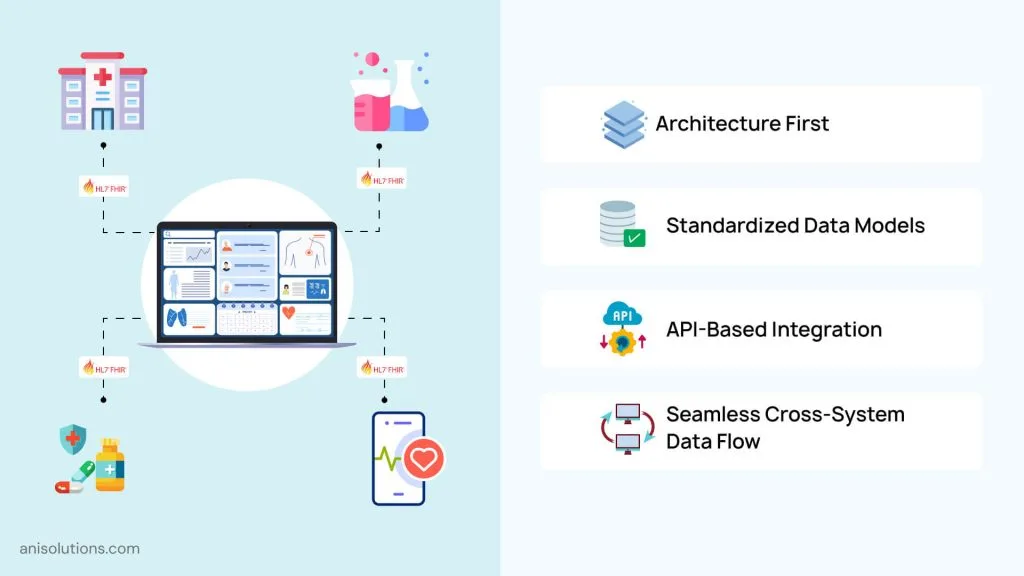
Interoperability is no longer an optional capability—it is a fundamental architectural requirement. Modern EHR systems must exchange data securely and consistently with hospitals, laboratories, pharmacies, imaging platforms, and other healthcare applications.
Designing interoperability into the architecture from the beginning reduces integration complexity and improves care coordination across the healthcare ecosystem.
To understand the architectural frameworks behind real-time data exchange, read this blog: How to Build a Fully Interoperable EHR.
Scalability & Performance: Designing EHR Architecture for Multi-Clinic Growth
Many EHR systems work well when used by a single clinic, but begin to struggle as organizations grow. With each new location, provider, or service line, the complexity increases and creates architectural weaknesses.
As healthcare organizations expand, their EHR architecture must support additional clinics, providers, specialties, and patient volumes without compromising performance. Scalable architectures use modular services, centralized governance, and efficient data management to accommodate long-term growth.
Planning for scalability early reduces technical debt and avoids costly architectural redesigns later. Read this blog: Scaling EHR for Multi-Clinic Use.
Best Practices for EHR Software Architecture
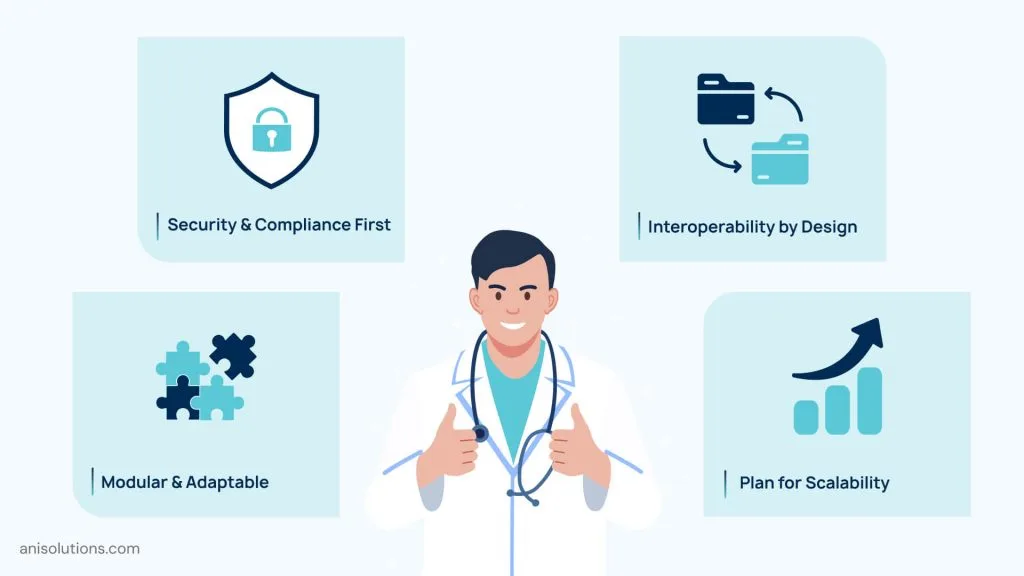
Designing a successful EHR system isn’t just about choosing the right technologies; it’s about making sound architectural decisions early. The following best practices help ensure that EHR software architecture remains resilient, compliant, and adaptable as clinical and business needs evolve.
1. Build Security & Compliance Into the Core Design
Security and compliance should be embedded at the architectural level, not added later as features. Role-based access control, audit logging, and data protection mechanisms must be enforced consistently across all modules, workflows, and integrations.
2. Design for Interoperability From the Beginning
Interoperability works best when EHR systems are designed to exchange data from day one. Supporting standardized data exchange and API-based access early prevents costly rework and reduces integration complexity as the system grows.
3. Keep the Architecture Modular & Adaptable
Modular architecture allows individual components, such as workflows, reporting, or integrations, to evolve independently. This reduces system-wide risk when changes are required and makes it easier to introduce new capabilities without disruption.
4. Plan for Scalability Before Growth Demands It
Scalability should be a part of the EHR architecture, rather than a future fix. Designing for increased user, clinics, and data volume upfront helps maintain performance and avoids architectural redesigns as the organization expands.
Choosing the Right Architecture for Your EHR Vision
If you’re reading till now, one thing should be clear: EHR software architecture is not a technical detail; it’s a long-term strategic choice. The architecture you choose will shape how your EHR performs, scales, integrates, and adapts to regulatory and clinical change over time.
Before committing to development or modernization, healthcare organizations need to step back and evaluate whether their architectural direction truly supports their goals.
1. Key Questions to Ask Before EHR Development
Choosing the right architecture starts with asking the right questions:
- Does the architecture align with how clinicians actually work today?
- Can it support future workflows, service lines, or care models?
- How easily can it adapt to new compliance requirements?
- Will integrations and extensions require core system changes?
- Is the architecture designed to scale without degrading performance?
These questions help shift the conversation from features and UI preferences to structural readiness.
2. Aligning Architecture With Clinical & Business Goals
Strong EHR architecture connects clinical efficiency with operational priorities. When architectural decisions are aligned with both care delivery and business objectives, organizations gain:
- Faster adoption by clinical teams
- Greater flexibility to innovate
- Lower long-term maintenance and redesign costs
This alignment is especially critical for organizations investing in architecture for custom EHR solutions, where early decisions have a lasting impact.
3. Avoiding Costly Redesigns Through Early Planning
Many EHR initiatives fail not because of poor execution, but because architectural decisions were made too late or revisited too often. Investing time in architectural planning upfront reduces rework, minimizes risk, and creates a more predictable development path.
Evaluate Your EHR Architecture Readiness Assessment
Get NowConclusion: Why EHR Software Architecture Is a Long-Term Strategic
EHR software architecture is the foundation on which the entire EHR system works. So, if your architecture is not robust enough, then everything from performance to security and compliance gets affected tremendously.
Many common EHR challenges stem from architectural limitations rather than surface-level design issues. Organizations that prioritize architecture early are better able to support complex workflows, integrate new technologies, and respond to regulatory change without constant redesign.
Whether building a customizable EHR or modernizing an existing system, investing in the right architectural approach reduces risk and creates a platform that can grow with your clinical and business needs.
If you are planning to build your EHR, now is the right time to evaluate whether your architecture truly supports your long-term vision. Click here to book your demo and take the first step in building the robust EHR software architecture.
Frequently Asked Questions
EHR software architecture defines how an EHR system is structured and how its components work together. It’s important because it directly affects performance, security, interoperability, scalability, and how well the system adapts to modern healthcare needs.
Key components include the presentation layer, business logic layer, data and storage layer, integration layer, and security layer. Together, these layers ensure smooth workflows, secure data handling, reliable integrations, and long-term system stability.
EHR architecture is designed for interoperability and data sharing across systems, while EMR architecture typically focuses on internal clinical documentation within a single organization. EHRs support broader care coordination, integrations, and long-term scalability.
Features can be added or changed over time, but architecture determines how flexible, secure, and scalable the system can be. Poor architecture limits performance and growth, no matter how advanced or attractive the features appear.
Modern EHR architecture uses modular design, APIs, and scalable infrastructure. This allows organizations to add clinics, users, and services without redesigning the system, while maintaining performance and avoiding operational disruptions.
HIPAA compliance is easier when security, access controls, audit logs, and data protection are built into the architecture. Architectural enforcement ensures compliance is consistent across workflows, integrations, and system updates—not added later as patches.
Essential elements include role-based access control, encryption, centralized audit logging, secure data storage, and controlled APIs. These architectural safeguards protect patient data while supporting clinical workflows and regulatory requirements.
Yes. Poor architecture often creates gaps in access control, audit trails, and data handling. These weaknesses increase the risk of data breaches, failed audits, and non-compliance—especially as systems scale or integrate with external platforms.
API-first architecture designs system communication upfront, allowing different EHR components and external tools to connect through APIs. This makes integrations easier, reduces system dependencies, and supports faster updates without disrupting core workflows.
API-first design allows new tools, services, and workflows to connect without modifying the core system. This improves flexibility, speeds up integrations, and enables EHR platforms to evolve gradually instead of requiring risky system-wide changes.
A&I Solutions
Continue the conversation
Explore more blog or contact our team about your goals.