

Healthcare interoperability
Trusted By 500+ U.S. Healthcare Providers
Eliminate Data Silos with Advanced Healthcare Interoperability Solutions
Design and implement secure, standards-based healthcare interoperability services using HL7 Fast Healthcare Interoperability Resources (FHIR), SMART on FHIR integration, and API-driven architecture to unify fragmented systems and enable real-time healthcare data interoperability across your ecosystem.
Proven Interoperability Outcomes Across Healthcare Systems
Real outcomes from healthcare organizations implementing advanced interoperability & integration solutions
Reduction in Manual Data Entry
System-to-System Data Exchange
Reduction in Data Silos
HIPAA-Aligned Secure Data Exchange
What Sets A&I Healthcare Interoperability & Integration Apart?
See how A&I’s interoperability specialists and compliance-driven integration framework eliminate data silos, ensure secure health data exchange, and outperform traditional integration vendors.
Interoperability-focused engineers
Deep expertise in healthcare data exchange standards and workflows
Compliance built into every integration
HIPAA, HITECH, and ONC-aligned implementation from day one
Advanced HL7 & FHIR integration specialists
Proven experience with real-world EHR interoperability
Security-first architecture design
Encrypted APIs, audit trails, and governed data exchange
End-to-end integration ownership
Strategy, implementation, validation, and long-term support
Build a Connected Healthcare Ecosystem with Secure Integration and Interoperability in Healthcare
Secure healthcare interoperability solutions connecting EHRs, devices, and billing systems through standards-based integration and real-time data exchange.
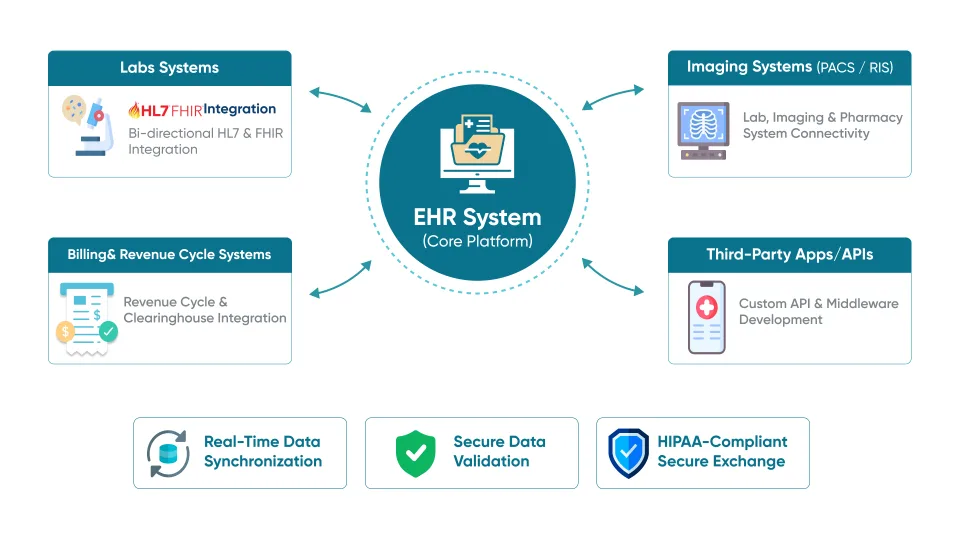
EHR Integration
Leverage EHR integration services seamlessly connect EHR systems with labs, billing platforms, pharmacies, and third-party applications to enable secure, real-time health data exchange and eliminate fragmented clinical workflows.
- Bi-directional HL7 & FHIR integration
- Lab, imaging & pharmacy system connectivity
- Revenue cycle & clearinghouse integration
- Custom API & middleware development
- Real-time data synchronization & validation
FHIR Capabilities & Smart on FHIR
Implement FHIR Fast Healthcare Interoperability Resources frameworks to enable semantic interoperability in healthcare and scalable API ecosystems with SMART on FHIR integration.
- SMART on FHIR app development
- FHIR resource structuring & validation
- FHIR server deployment & optimization
- OAuth2 & secure API authorization
- EHR vendor FHIR customization
Interface Engine Platform Migration & Modernization
Modernize legacy integration systems with scalable interface engine modernization to improve healthcare IT interoperability and performance.
- Legacy interface engine migration
- API-first integration architecture design
- Cloud-based integration platform deployment
- Data integrity validation & reconciliation
- Hybrid on-prem & cloud system integration
Medical Device & Wearable Integration
Enable secure medical device integration to support real-time healthcare data interoperability and remote patient monitoring.
- RPM device data ingestion
- IoT healthcare data pipelines
- Real-time vitals synchronization
- Signal filtering & anomaly detection
- Device-to-EHR secure integration
e-Prescriptions Integration
Implement secure ePrescription integration aligned with interoperability standards in healthcare to streamline medication workflows.
- eRx API integration with EHR systems
- Pharmacy network connectivity (retail & mail-order)
- Real-time prescription transmission
- Medication history retrieval
- Drug-drug & allergy interaction data sync
Billing & Clearinghouse Integration
Streamline revenue operations with billing and clearinghouse integration powered by secure healthcare interoperability solutions.
- Claims submission API integration
- Real-time eligibility & benefits verification
- ERA (Electronic Remittance Advice) integration
- Claim status tracking & reconciliation
- Denial management data exchange
Trusted by Healthcare Leaders for Seamless Interoperability
From health systems to growing clinics, our clients trust us to deliver secure, scalable integrations that power connected, efficient care.
North Valley Medical Center
Regional Hospital Network
Challenge:
Fragmented EHR, lab, and billing systems created workflow inefficiencies and delayed clinical data access across departments.
Results:
- Unified systems through HL7 & FHIR-based integrations
- Enabled real-time data exchange across clinical and revenue platforms
- Improved cross-department coordination
Reduction in Manual Data Reconciliation
Faster Lab Result Availability
Integration Uptime
99.9%
"A&I transformed how our systems communicate. We now have real-time visibility across departments without worrying about data gaps or delays. "
Melissa Grant
CIO, North Valley Medical Center
Horizon Specialty Clinics
Multi-Location Specialty Care Group
Challenge:
Rapid expansion led to disconnected systems across new locations, creating data silos and compliance risks.
Results:
- Implemented standardized FHIR APIs across all sites
- Centralized integration governance
- Strengthened HIPAA-aligned data exchange
Reduction in Cross-System Data Errors
Faster Onboarding for New Locations
Audit-Ready Integration Framework
100%
"Their interoperability team gave us structure and scalability. We expanded without sacrificing compliance or system performance. "
Daniel Perez
VP of Technology, Horizon Specialty Clinics
BrightPath Digital Health
Telehealth & Remote Monitoring Provider
Challenge:
Needed secure device-to-EHR integration to support real-time remote patient monitoring at scale.
Results:
- Integrated wearable and RPM devices directly into EHR workflows
- Built secure API pipelines for continuous data ingestion
- Enabled automated vitals monitoring
Automation in Device Data Capture
Reduction in Manual Monitoring Tasks
Faster Clinical Response Time
"A&I helped us move from isolated device data to actionable clinical insights inside the EHR. That changed everything for our care model. "
Laura Chen
Chief Product Officer, BrightPath Digital Health
SummitCare Health System
Integrated Care Delivery Network
Challenge:
Legacy interface engines were slowing system performance and causing message routing failures.
Results:
- Migrated legacy interface engine to a scalable integration platform
- Optimized HL7 message routing & monitoring
- Implemented real-time error alerts
Reduction in Interface Errors
Faster Message Processing
Critical Downtime During Migration
Zero
"The modernization process was seamless. We improved performance dramatically without disrupting clinical operations. "
Robert Kim
Director of Health IT, SummitCare Health System
Is Your Healthcare System Truly Interoperable?
Evaluate your integration strategy, eliminate data silos, and unlock secure healthcare data interoperability.
Frequently Asked Questions
Q. What is healthcare interoperability?
Healthcare interoperability is the ability of different healthcare IT systems to securely exchange, interpret, and use patient data in real time. It enables seamless healthcare data interoperability across EHRs, devices, billing systems, and external partners.
Q. Why is interoperability important for modern healthcare systems?
Interoperability in healthcare ensures that providers have accurate, complete patient data at the point of care. It improves clinical decision-making, reduces duplicate testing, enhances care coordination, and strengthens healthcare IT interoperability across organizations.
Q. What is the difference between interoperability and system integration in healthcare?
System integration connects applications, while healthcare interoperability ensures those systems can exchange, interpret, and use shared data meaningfully. True interoperability in healthcare supports semantic interoperability, not just technical connectivity.
Q. What are the main types of healthcare interoperability?
The three main types are: Foundational interoperability (basic data exchange) Structural interoperability (standardized data format using healthcare interoperability standards like HL7 FHIR) Semantic interoperability in healthcare (shared meaning and interpretation of data)
Q. What technologies and standards enable healthcare interoperability?
Healthcare interoperability solutions rely on standards such as HL7 Fast Healthcare Interoperability Resources (FHIR), SMART on FHIR integration, X12 EDI, and API-based healthcare interoperability platforms to enable secure, scalable data exchange.
Q. How does health data exchange improve patient care and safety?
Secure healthcare data interoperability enables providers to access complete medical histories, lab results, and medication data in real time. This reduces errors, prevents duplicate treatments, and improves overall patient safety.
Q. What challenges prevent seamless interoperability in healthcare organizations?
Common challenges include legacy systems, lack of standardized healthcare interoperability standards, fragmented healthcare IT infrastructure, compliance concerns, and limited integration and interoperability in healthcare strategies.
Q. What is a Health Information Exchange (HIE), and how does it support data sharing?
A Health Information Exchange (HIE) is a network that enables secure healthcare data interoperability between hospitals, clinics, labs, and payers. HIEs support regional and national healthcare IT interoperability initiatives.
Q. How do interoperable systems reduce operational inefficiencies?
Healthcare interoperability services reduce manual data entry, eliminate redundant documentation, and automate workflows. This improves efficiency, minimizes administrative burden, and supports scalable healthcare interoperability solutions.
Q. How does interoperability improve care coordination and workflow efficiency?
By enabling real-time healthcare data exchange across EHRs, devices, and billing systems, interoperable platforms enhance collaboration between providers and streamline clinical and operational workflows.
Q. What role do compliance and data security play in interoperable systems?
Healthcare interoperability must align with HIPAA and other healthcare IT interoperability regulations. Secure APIs, encrypted data exchange, access controls, and audit trails ensure compliant and protected health information sharing.
Q. What should healthcare organizations consider when building an interoperability strategy?
Organizations should evaluate existing infrastructure, choose scalable healthcare interoperability platforms, adopt healthcare interoperability standards like HL7 FHIR, ensure compliance, and plan for long-term integration and interoperability in healthcare.