

Connected healthcare devices
Trusted By 500+ U.S. Healthcare Providers
Medical Device & Wearable Integration Services for Connected Healthcare
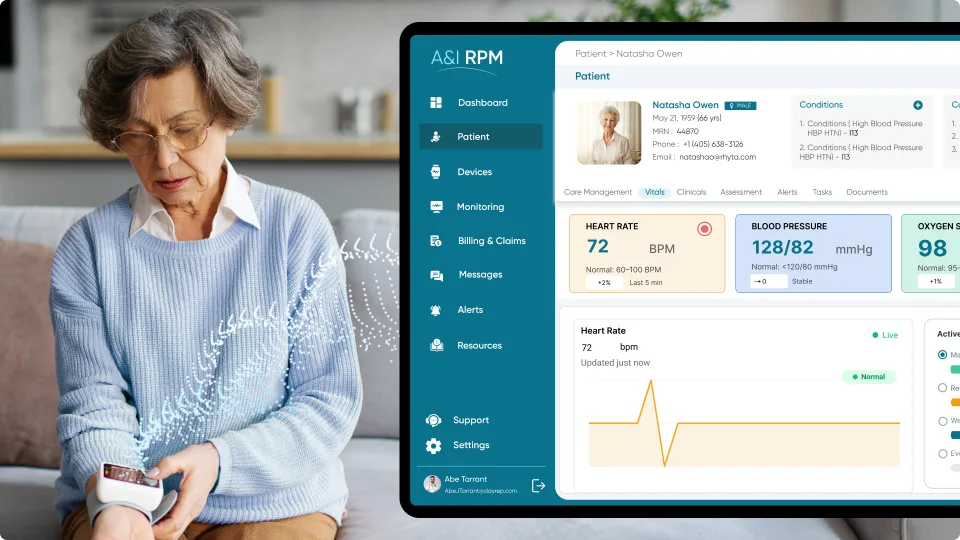
Connect medical devices, RPM systems, and wearable technologies to your healthcare platforms with secure data pipelines, real-time medical device data integration, intelligent signal filtering, and seamless EHR integration for continuous, data-driven patient monitoring.
Published Figures
Medical Devices & Wearables Integrated
Vitals Data Points Processed Daily
Real-Time Data Synchronization
FHIR / HL7 Ready
Powering Real-Time Patient Monitoring Through Connected Devices
Proven outcomes from medical device and wearable integrations
RPM Device Data Ingestion
IoT Healthcare Data Pipelines
Real-Time Vitals Synchronization
Signal Filtering & Anomaly Detection
Device-to-EHR Secure Integration
Build a Connected Monitoring Ecosystem with Medical Device EHR Integration
Enable continuous remote patient monitoring and real-time clinical insights from real-time medical device data integration & FHIR-based medical device integration.
RPM Device Data Ingestion
Collect patient vitals from remote monitoring devices and wearables through secure ingestion frameworks, enabling reliable data capture for continuous monitoring. Our remote patient monitoring device integration services ensure scalable and secure wearable health data integration.
- Multi-device Data Collection
- Continuous Patient Vitals Capture
- Secure Device Connectivity
- Scalable Data Ingestion Pipelines
- Remote Monitoring Device Support
IoT Healthcare Data Pipelines
Build scalable pipelines to process and transport medical device data across healthcare systems. Our medical IoT integration services support IoMT integration for healthcare, enabling structured, secure, and real-time movement of patient-generated health data.
- Scalable IoT Data Architecture
- Real-Time Data Processing
- Device Data Normalization
- Encrypted Device Data Transmission
- High-Volume Health Data Handling
Real-Time Vitals Synchronization
Integrate medical device and wearable data directly into EHR systems for streamlined workflows. Our medical device EHR integration services ensure FHIR-based interoperability and HIPAA-compliant medical device integration across healthcare platforms.
- Continuous Vitals Monitoring
- Real-Time Device Data Sync
- Low-Latency Data Transmission
- Cross-System Data Availability
- Clinical Monitoring Dashboards
Signal Filtering & Anomaly Detection
Filter noise from device signals and detect abnormal health patterns using intelligent analytics. Our approach enhances wearable health data integration services by improving data accuracy and enabling early identification of potential health risks.
- Signal Noise Reduction
- Intelligent Data Filtering
- Anomaly Detection Algorithms
- Early Health Risk Alerts
- Clinical Data Accuracy Enhancement
Device-to-EHR Secure Integration
Integrate medical device and wearable data directly into EHR systems for streamlined workflows. Our medical device EHR integration services ensure FHIR-based interoperability and HIPAA-compliant medical device integration across healthcare platforms.
- Secure EHR Data Integration
- FHIR & HL7 Interoperability
- HIPAA-Compliant Data Exchange
- Automated Patient Data Updates
- Cross-System Clinical Data Access
Real Results from Medical Device & Wearable Integrations
See how healthcare organizations are improving clinical workflows, operational efficiency, and revenue performance with AI-powered solutions.
Remote Patient Monitoring
Horizon Telehealth Network
Challenge:
Managing patient vitals from multiple wearable devices and RPM systems created fragmented data streams. Care teams struggled to access real-time patient information from connected monitoring devices.
Result:
- Unified wearable and medical device data across monitoring systems
- Enabled real-time patient vitals visibility for care teams
- Reduced delays in identifying abnormal health patterns
Patients monitored:
1,200+
Vitals data processed daily:
75K+
Device integration time reduced:
-55%
"Their device integration framework allowed us to unify wearable and medical device data across our monitoring platform. Clinicians now have reliable real-time patient vitals, enabling faster responses and more proactive care management."
Dr. Angela Morris
Chief Medical Officer, Horizon Telehealth Network
Digital Health Platform
PulseTrack Health
Challenge:
Integrating multiple wearable devices and remote monitoring technologies into our health platform required scalable data pipelines capable of handling high-volume patient-generated health data.
Result:
- Built scalable IoT pipelines for wearable health data
- Enabled secure processing of high-volume vitals streams
- Improved system performance for device-based monitoring programs
Connected devices:
Vitals data points processed daily:
120K+
Data pipeline performance improvement:
"Their IoT healthcare data pipelines helped us scale device integrations seamlessly. We can now process massive volumes of wearable health data while maintaining secure and reliable system performance."
Michael Chen
VP of Engineering, PulseTrack Health
Telehealth Provider
CareBridge Virtual Care
Challenge:
Our telehealth platform lacked real-time visibility into patient vitals from connected monitoring devices, making it difficult for clinicians to identify health risks early.
Result:
- Enabled real-time synchronization of patient vitals
- Improved clinician visibility into remote patient health data
- Accelerated response to potential health risks
Patients in monitoring programs:
900+
Real-time vitals synchronization reliability:
99.9%
Clinical response time improvement:
"Real-time vitals synchronization has transformed how our care teams monitor patients remotely. Clinicians now receive continuous updates from wearable devices and can intervene earlier when abnormalities appear."
Dr. James Patel
Medical Director, CareBridge Virtual Care
Chronic Care Management
VitalCare Management Group
Challenge:
Device-generated patient data often contained signal noise and inconsistencies, making it difficult to identify clinically meaningful health patterns.
Result:
- Implemented intelligent filtering for device signal noise
- Improved accuracy of patient-generated health data
- Enabled earlier identification of abnormal health trends
Patients monitored:
1,500+
Device signal accuracy improvement:
Early health alerts detected:
"Their signal filtering and anomaly detection capabilities dramatically improved the quality of our patient monitoring data. Our care teams now receive clearer insights and can detect potential health risks much earlier."
Dr. Laura Bennett
Director of Care Management, VitalCare Management Group
Healthcare Technology Platform
MedConnect Solutions
Challenge:
Integrating wearable and medical device data into our EHR workflows required secure interoperability and standardized health data exchange across systems.
Result:
- Enabled seamless device-to-EHR data synchronization
- Reduced manual handling of patient monitoring data
- Improved accessibility of vitals data within clinical workflows
Devices integrated:
EHR data sync speed:
Manual data entry reduction:
"Secure device-to-EHR integration has enabled us to deliver continuous patient monitoring insights directly within clinical workflows. The interoperability capabilities significantly improved our platform's efficiency."
Daniel Rodriguez
CTO, MedConnect Solutions
Integrate Medical Devices & Wearables for Connected Care
Enable real-time patient monitoring with secure device integration and seamless EHR connectivity.
Frequently Asked Questions
Q. What is medical device and wearable integration in healthcare?
Medical device and wearable integration connects patient monitoring devices and wearables to healthcare systems, such as EHRs. It enables automatic data capture, real-time vitals tracking, and continuous patient monitoring, helping clinicians access accurate data without manual entry and improving overall care coordination and decision-making.
Q. Which medical devices and wearables can be integrated with EHR systems?
A wide range of devices can be integrated, including blood pressure monitors, glucose meters, pulse oximeters, ECG devices, smartwatches, and fitness trackers. These devices generate patient health data that can be securely transmitted and synced with EHR systems for continuous monitoring and clinical use.
Q. How long do medical device integration services typically take?
The timeline depends on the number of devices, integration complexity, and interoperability requirements. Simple integrations may take a few weeks, while complex, multi-device ecosystems with EHR connectivity and compliance considerations can take several months to fully implement and optimize.
Q. What is the cost of medical device integration services?
Costs vary based on device types, data volume, integration complexity, and compliance requirements. Basic integrations are more affordable, while advanced solutions involving real-time data processing, IoMT pipelines, and EHR interoperability require higher investment due to customization and scalability needs.
Q. How is HIPAA compliance maintained during medical device integration?
HIPAA compliance is ensured through encrypted data transmission, secure APIs, access controls, and audit trails. Integration frameworks are designed to protect patient data during collection, processing, and storage, ensuring all data exchanges between devices and healthcare systems meet strict regulatory standards.
Q. What standards are used for medical device integration and interoperability?
Common standards such as HL7, FHIR, and DICOM enable structured, consistent data exchange across healthcare systems. These standards ensure interoperability among devices, platforms, and EHRs, enabling seamless communication and reducing integration complexity across technologies.
Q. Can wearable device data be integrated into an EHR in real time?
Yes, wearable device data can be integrated in real time using secure data pipelines and APIs. Real-time integration enables continuous syncing of patient vitals into EHR systems, allowing clinicians to monitor patients proactively and respond quickly to abnormal health patterns.
Q. How does medical device integration support remote patient monitoring programs?
Medical device integration enables continuous collection and transmission of patient vitals from remote monitoring devices. This allows care teams to track patient health outside clinical settings, identify early warning signs, and intervene proactively, improving outcomes and reducing hospital readmissions.
Q. What regulatory requirements apply to medical device integration services?
Medical device integration must comply with regulations such as HIPAA for data privacy and FDA guidelines for device safety. Additionally, interoperability standards and secure data-handling practices must be followed to ensure safe, compliant, and reliable integration in healthcare environments.
Q. What should healthcare organizations look for in a medical device integration service provider?
Organizations should seek expertise in healthcare interoperability, EHR integration, and compliance with standards such as HIPAA and FHIR. A reliable provider should offer scalable architecture, real-time data capabilities, and experience integrating multiple devices while ensuring security, performance, and long-term support.
Q. Can medical device integration be implemented without replacing the existing EHR system?
Yes, medical device integration can be implemented without replacing your existing EHR. Integration layers and APIs allow seamless connection between devices and current systems, enabling data exchange and workflow improvements without disrupting existing infrastructure or requiring a complete system overhaul.
Q. How do medical device integration services improve clinical workflows and outcomes?
Medical device integration automates data capture, reduces manual entry, and provides real-time access to patient vitals. This improves clinical efficiency, enhances decision-making, enables proactive care, and supports better patient outcomes by ensuring the availability of accurate, timely, and continuous health data.