
A&I Case Study
A&I Custom EHR with Voice Commands for Hands-Free Charting
How a multi-site ambulatory care provider replaced keyboard-driven documentation with voice-enabled clinical workflows—reducing charting time, improving provider efficiency, and allowing clinicians to stay focused on patient care.
How a multi-site ambulatory care provider replaced keyboard-driven documentation with voice-enabled clinical workflows—reducing charting time, improving provider efficiency, and allowing clinicians to stay focused on patient care.
Keyboard-driven documentation slowed clinical workflows
The client is a U.S.-based multi-specialty outpatient provider group operating 12 clinics and serving more than 275,000 patients annually. Providers relied on manual keyboard entry for clinical documentation, requiring them to alternate between patient interactions and the EHR throughout each encounter.
As patient volumes increased, documentation became one of the largest contributors to provider workload, extending chart completion beyond clinic hours and reducing face-to-face engagement. The client partnered with A&I Solutions to build voice-enabled clinical documentation directly into its EHR, enabling hands-free charting without disrupting existing workflows.
Manual documentation transformed into voice-enabled clinical workflows
The Challenge
- Providers spent significant time typing clinical documentation during and after patient visits.
- Keyboard-based charting interrupted patient conversations and reduced provider engagement.
- Delayed documentation increased after-hours charting and slowed downstream billing workflows.
Our Solution
- Voice commands enabled hands-free navigation and documentation inside the EHR.
- Speech recognition automatically converted dictated notes into structured clinical records.
- Real-time documentation synchronized directly with patient charts and downstream workflows.
A voice-enabled clinical documentation platform integrated into the EHR
A cloud-based voice recognition layer captured provider speech, converted it into structured clinical documentation, and synchronized data directly with the EHR using FHIR R4 APIs and HL7 v2.x messaging. Built on Microsoft Azure with Azure Speech Services, OAuth 2.0, RBAC, and HIPAA-compliant audit logging, the platform securely supported hands-free documentation across all clinic locations.
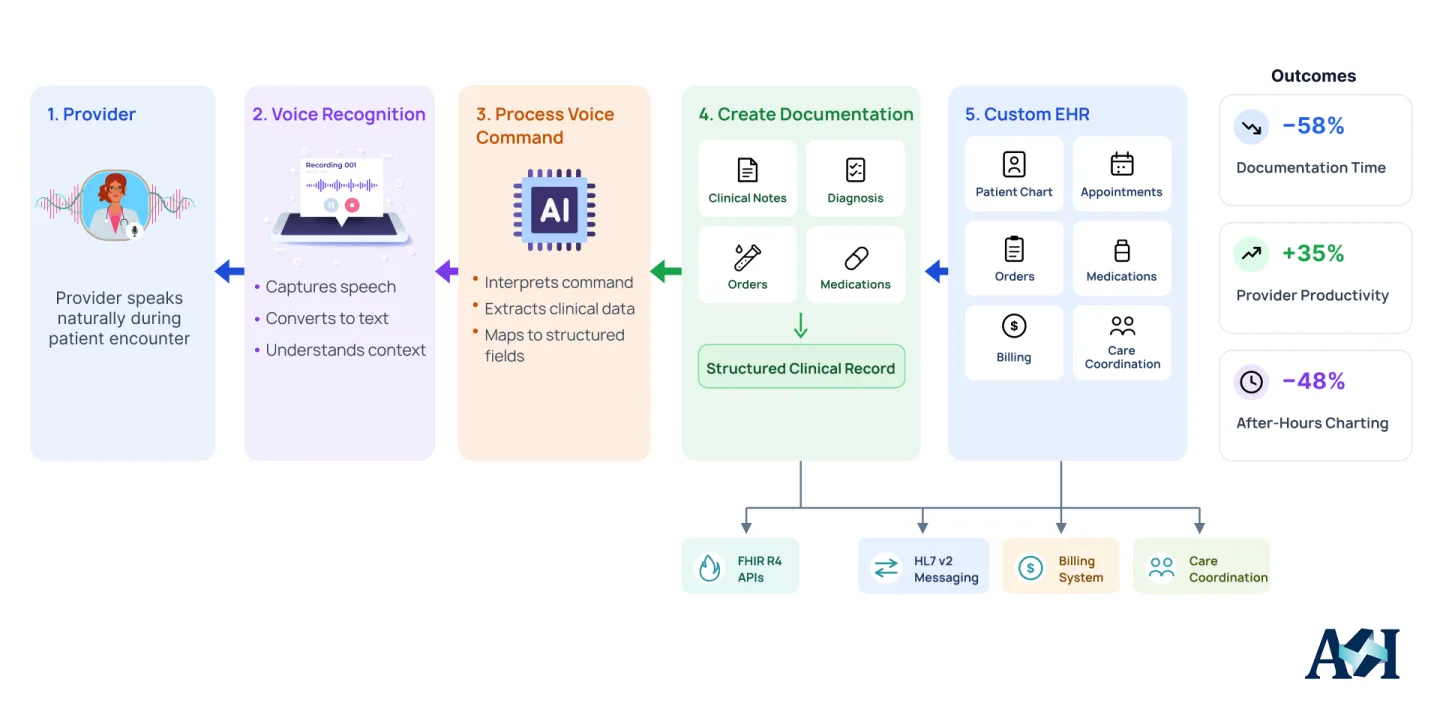
Voice-enabled custom EHR development for efficient clinical documentation
A&I Solutions designed and implemented voice-enabled functionality within the client’s EHR, allowing providers to navigate screens, dictate notes, complete documentation, and execute common clinical actions using voice commands. Built on Microsoft Azure using Azure Speech Services, FHIR R4, and HL7 v2.x, the solution streamlined documentation while maintaining provider control over every patient record.
Through the A&I Solutions project delivery approach, the implementation demonstrated how custom EHR development can deliver intelligent documentation workflows through scalable custom EHR software.
1. Hands-free clinical documentation
To reduce manual typing, the team developed voice-enabled workflows that allowed providers to complete documentation naturally during patient encounters.
- Voice-powered navigation across EHR screens
- Speech-to-text clinical note generation
- Voice commands for orders, medications, and documentation shortcuts
2. Integrated voice workflow
To maintain familiar clinical workflows, voice-enabled functionality was integrated directly into the client’s EHR and supporting healthcare systems.
Automatically populated encounter notes into structured patient records with provider review before finalization.
Voice commands accelerated medication entry, laboratory orders, and common documentation tasks.
Structured documentation flowed directly into billing, coding, and care coordination workflows without duplicate data entry.
Protected voice recordings and clinical information using Microsoft Azure, OAuth 2.0, RBAC, SSO, encrypted storage, and HIPAA-compliant audit logging.
Measurable outcomes after go-live
Less documentation time
Voice-enabled charting significantly reduced the time providers spent creating clinical notes while maintaining documentation accuracy through provider review.
Higher provider productivity
Hands-free workflows allowed providers to complete more documentation during scheduled clinic hours while reducing workflow interruption
Less after-hours charting
Completing documentation during patient encounters reduced evening charting and accelerated downstream billing and care coordination processes.
A&I Solutions
Continue the conversation
Explore more case studies or contact our team about your goals.