
A&I Insights
In-House vs Outsourced EHR Development: How to Choose
When you decide to build your own EHR and EMR, the first question that often comes up is about how to build it and whether to go in-house or outsource development. And this is where deciding what your final goals are is important. In thi…
Published
When you decide to build your own EHR and EMR, the first question that often comes up is about how to build it and whether to go in-house or outsource development.
And this is where deciding what your final goals are is important. In this, one more factor is custom EHR feature prioritization, as it also helps you find which specialties you are going to need.
For instance, if you want to build AI-powered capabilities in your EHR and your in-house team lacks the expertise, then you can go for EHR development outsourcing. Whereas, if you have resources to build your own team for designing and monitoring the custom EHR, then going with an in-house development approach can be your best option.
Additionally, factors like delivery speed, resource availability, and execution approach directly impact how fast your EHR is developed.
This is where comparing in-house vs outsourced EHR Development becomes critical. Rather than just going with an option based on surface-level analysis, it’s best to see their pros and cons in depth and make sure it is the right option for your organization.
In this blog, we will walk you through choosing between in-house and outsourced EHR teams so you can choose the best option that makes your EHR development easier and not harder to manage.
EHR Development Model Readiness Checklist (In-House vs Outsourced)
Get NowHow Development Models Impact EHR Feature Prioritization
Before comparing benefits and risks of EHR development in-house vs outsourcing, it’s important to understand what in-house vs outsourced EHR development really means. If you see it on paper, the difference looks straightforward. However, in reality, the difference goes much deeper, including compliance requirements, complexity, and development time.
If you’re deciding how to build a custom EHR, the right approach depends on your organization’s internal capabilities, timeline, budget, and long-term goals. The table below compares the factors healthcare leaders typically evaluate before choosing a development model.
| Decision Factor | In-House Development | Outsourced Development |
| Best For | Organizations with mature healthcare IT teams and long-term product ownership | Organizations that need specialized expertise, faster delivery, or additional development capacity |
| Time to Market | Typically longer due to hiring and internal resource constraints | Faster delivery using experienced healthcare development teams |
| Healthcare Expertise | Depends on internal hiring and training | Immediate access to EHR, HL7, FHIR, HIPAA, and interoperability expertise |
| Upfront Investment | Higher due to recruitment, infrastructure, and ongoing staffing | Lower upfront hiring costs with predictable engagement models |
| Control Over Product | Full ownership of priorities, roadmap, and technical decisions | Shared governance with agreed project milestones and deliverables |
| Scalability | Requires expanding internal teams | Resources can scale up or down as project needs change |
| Best Choice If… | You have experienced internal resources and want complete product ownership | You need to launch faster, fill skill gaps, or reduce execution risk |
In summary: Neither model is universally better. The right choice depends on your organization’s technical maturity, delivery timeline, budget, and long-term product strategy.
If you’re still evaluating the foundational process, here’s a detailed step-by-step guide to building an EHR system that walks through architecture, compliance, and development planning.
In-House Development: Control Over EHR Feature Prioritization
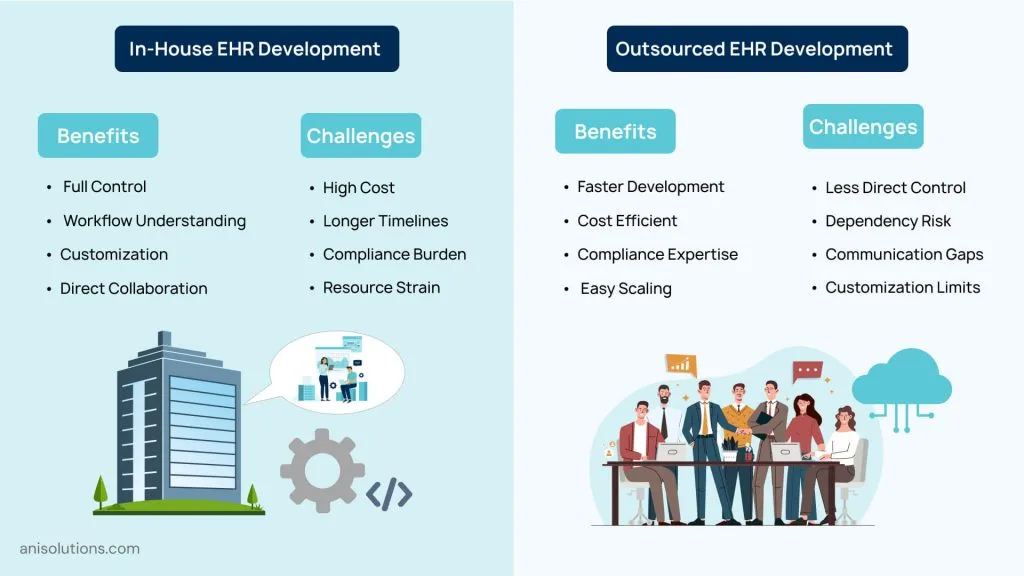
For healthcare organizations with strong internal IT maturity, in-house EHR development can feel like the most natural option. Building internally offers a sense of ownership and control that’s hard to replicate, especially when the EHR is tightly woven into daily clinical and operational workflows.
One of the biggest advantages of in-house EHR development is greater control over the product roadmap. Internal teams can prioritize features based on immediate clinical needs, regulatory updates, or leadership direction—without negotiating scope or timelines with external vendors. This level of control is especially valuable for organizations with highly specialized workflows or long-term product visions.
Another clear benefit is the deep understanding of internal clinical and operational workflows. In-house teams work closely with clinicians, administrators, and billing staff, which helps translate real-world processes into system logic more accurately. Over time, this proximity can lead to better usability and tighter alignment between technology and care delivery.
That said, there are some crucial in-house EHR development challenges that you need to understand before committing to this option. Hiring and retaining engineers with healthcare-specific expertise—especially around HL7/FHIR, security, and compliance—is difficult and expensive.
Another factor that slows delivery is bandwidth limitation as teams balance EHR work with operational support and maintenance tasks. As complexity grows, these constraints can lead to longer timelines, rising costs, and delayed innovation, even when the strategic intent is sound.
So, when EHR development is done in-house, it offers control, but it becomes costly and time-consuming with multiple priorities clashing during the development process.
Assess If In-House EHR Development Is the Right Choice For You
Assess NowOutsourced Development: Faster MVP and Feature Delivery
After understanding when in-house EHR development makes sense, it’s time to know when to outsource EHR development.
With outsourced EHR development, it is the best option when healthcare organizations need to move faster. Additionally, outsourcing teams handle technical complexity or extend capabilities that are difficult to sustain with internal teams.
So, rather than replacing internal teams, add outsourced teams as an extension to accelerate delivery while reducing execution risk, especially for custom EHR initiatives. One of the primary benefits of outsourcing EHR development is access to healthcare-specific expertise.
Experienced partners bring hands-on knowledge of interoperability standards, compliance requirements, and clinical workflow design, areas that the in-house team takes time to build. This allows organizations to avoid common learning curves and focus internal stakeholders on strategic and clinical priorities.
Another advantage is faster execution and easier scalability. Outsourced teams are structured to run parallel workstreams across development, integrations, testing, and security. As project needs change, resources can be scaled up or down without the long-term commitment of hiring, which is particularly valuable for complex or time-sensitive EHR programs.
However, outsourcing is not without risk. Governance gaps, unclear ownership, and weak communication can quickly derail progress. Compliance oversight also remains the organization’s responsibility, even when development is handled externally. Successful outsourcing depends on clear accountability, shared decision-making, and ongoing collaboration—not a hands-off approach.
When managed well, outsourced EHR development becomes a strategic extension of internal teams. When managed poorly, it introduces avoidable risk. Understanding these trade-offs is essential before choosing this model.
How to Prioritize EHR Features for Faster ROI
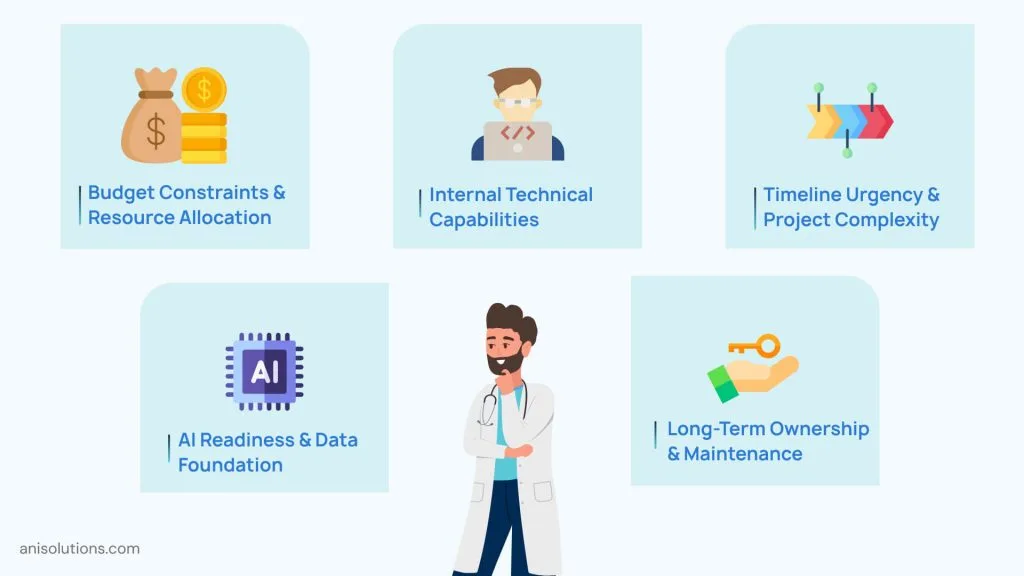
Once the differences between in-house and outsourced development are clear, the decision becomes less about preference and more about alignment. The right EHR development model is the one that fits your organization’s current capabilities, delivery expectations, and long-term strategy—not just today, but as clinical and regulatory demands evolve.
Start by assessing internal technical and healthcare IT capabilities. Organizations with experienced engineers, healthcare domain knowledge, and familiarity with interoperability and compliance may be well-positioned for in-house development. When those skills are limited or already stretched across operational systems, outsourcing can help close gaps without lengthy hiring cycles.
Timeline urgency and project complexity play an equally important role. Large-scale EHR builds, modernization initiatives, or integration-heavy projects often require parallel execution and faster turnaround, which can be difficult for small internal teams to sustain. In such cases, external partners can help maintain momentum without overloading internal staff.
It’s also critical to think beyond launch. Long-term ownership, maintenance, and compliance readiness demand ongoing investment, whether development is internal or outsourced. Finally, consider AI readiness and data maturity. If automation, analytics, or clinical documentation support are on your roadmap, your development model must support scalable architecture, clean data foundations, and continuous iteration.
So, before directly choosing the in-house vs outsourced EHR software development, carefully consider everything to get the most out of your investment.
EHR Development Decision Framework for Healthcare Leaders
Get NowFinal Take: Build the Right EHR Features First for Maximum ROI
Long story short, there is no definitive answer when it comes to in-house vs outsourced EHR development. Success depends on how well your chosen model aligns with your organization’s technical maturity, delivery timelines, compliance responsibilities, and long-term vision.
Making the decision early helps avoid downstream risk, cost overruns, and stalled innovations. However, the best approach is to go with a hybrid development model if possible.
If you are evaluating your options or planning a custom EHR software development, click here to connect with our team for a free consultation and expert guidance tailored to your goals.
Frequently Asked Questions
Internal teams with full ownership of delivery and maintenance handle in-house EHR development. Outsourced EHR development relies on external partners who bring healthcare expertise, scalable resources, and structured delivery while sharing governance responsibilities.
In-house development works best for organizations with mature healthcare IT teams, long-term development timelines, and stable funding. It’s often preferred when workflows are highly specialized, and leadership wants complete control over the product roadmap.
The biggest risks include poor governance, unclear ownership, communication gaps, and inadequate oversight of compliance. These issues typically arise when organizations treat outsourcing as hands-off instead of maintaining strong collaboration and accountability throughout development.
Strong internal expertise and flexible timelines favor in-house development. When skills are limited or timelines are tight, outsourcing helps accelerate delivery, reduce execution risk, and avoid long hiring cycles that can delay EHR initiatives.
AI-driven EHR features require clean data, scalable architecture, and rapid iteration. Organizations with limited AI or data engineering expertise often benefit from outsourced teams that have already implemented automation, analytics, and clinical documentation workflows.
A&I Solutions
Continue the conversation
Explore more blog or contact our team about your goals.