
A&I Insights
What Does EHR Customization Really Mean in 2026?
Have you ever thought about what EHR customization means? EHR customization is designing Electronic Health Records (EHR) around your healthcare organization’s specific clinical workflows, specialty requirements, operational processes, an…
Published
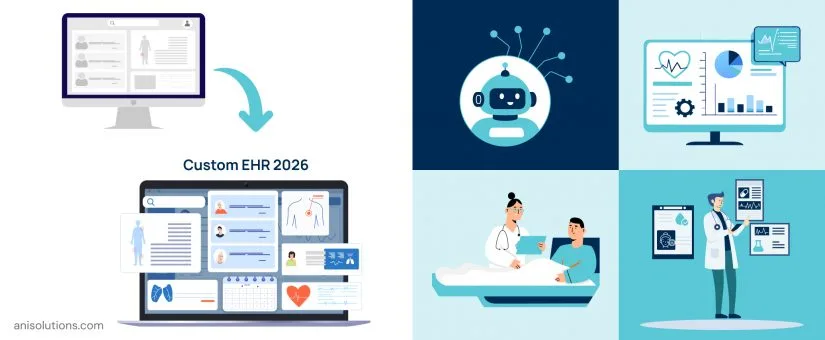
Have you ever thought about what EHR customization means?
EHR customization is designing Electronic Health Records (EHR) around your healthcare organization’s specific clinical workflows, specialty requirements, operational processes, and integration needs.
Unlike off-the-shelf software, which offers limited personalization and forces a healthcare organization to match how they really work. A tailored EHR allows organizations to improve workflows and get software that adapts to changing clinical, operational, and regulatory requirements.
So, in practical terms, you can tailor your EHR with modules, interfaces, and features that fit your organization’s workflows, processes, and specialties. Customization can range from configurable workflows and templates to purpose-built modules and integrations.
The goal is not simply to add more features. It is to make the EHR fit the organization’s way of working.
In this blog, we’ll walk through what a custom EHR is and an EHR selection framework to choose a tailored EHR that has all the features and functionality your healthcare organization needs, so you save time and money in developing your EHR.
What Does EHR Customization Mean in Practice?
By 2026, calling an EHR custom just because it allows a few field edits doesn’t cut it anymore. A truly personalized EHR solution is defined by how deeply it aligns with the way an organization delivers care—not how many checkboxes it lets you rearrange. The difference becomes obvious the moment workflows get complex.
- Standard EHR vs EHR Customization
A standard EHR provides predefined workflows designed for broad use across healthcare organizations. EHR customization, by contrast, is designed around an organization’s specific workflows, data flows, integrations, and reporting requirements. The difference is essentially who adapts: the organization to the software, or the software to the organization.
If you want a deeper technical breakdown of where EMRs and EHRs differ functionally, this distinction is explored further in our EMR vs EHR: Functional Differences Developers Must Understand guide.
- What Makes an EHR Custom?
A personalized EHR typically differs from a standard system through several areas:
- Workflow customization — clinical and administrative processes are designed around how the organization operates.
- Specialty-specific functionality — modules, templates, and workflows can reflect the requirements of particular specialties.
- Role-based experiences — physicians, nurses, care coordinators, and administrators can work with interfaces suited to their responsibilities.
- Integration flexibility — the system can connect with the external laboratories, devices, registries, billing systems, and healthcare platforms the organization uses.
- Configurable data and reporting — organizations can structure information and analytics around their own operational and clinical requirements.
Want to Understand How EMR Development Differs from EHR Development
Learn NowKey Features & Customizable Modules for Tailored EHR in 2026
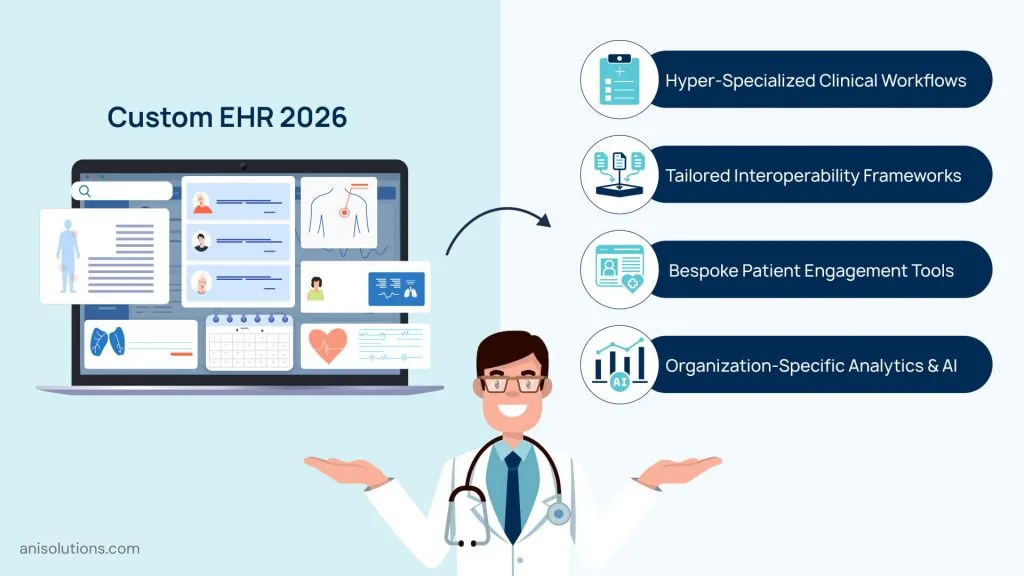
By 2026, features in an EHR aren’t about adding more functionality for the sake of it. They’re about precision—giving each organization exactly what it needs to deliver care efficiently, compliantly, and at scale. The most effective systems focus on modular flexibility, allowing teams to tailor capabilities without bloating the platform.
- Hyper-Specialized Clinical Workflows
If you are providing specialty-specific care, then an EHR tailored to your workflows is a need rather than a choice. A custom EHR platform easily supports specialty-specific documentation, templates, and department workflows. It perfectly reflects how clinicians provide care without making delivering specialty care a hassle.
- Tailored Interoperability Frameworks
A tailored EHR easily connects with other systems such as labs, pharmacies, and imaging centers without the add-ons of standardized EHRs. You can build interoperability standards such as HL7 and FHIR R4 into the architecture, bridging the gap between modern and legacy workflows and systems, keeping data flow smooth.
- Bespoke Patient Engagement Tools
Patient engagement tools can be tailored to factors such as age, condition, language, and digital comfort. Multilingual interfaces, accessibility options, and condition-specific education help create a more personalized patient experience.
- Organization-Specific Analytics & AI
Analytics, predictive models, and clinical decision support can be aligned with an organization’s patient population and care goals. Automation can also trigger workflows, alerts, and follow-ups based on how care is delivered.
Trends Defining Tailored EHR Software in 2026
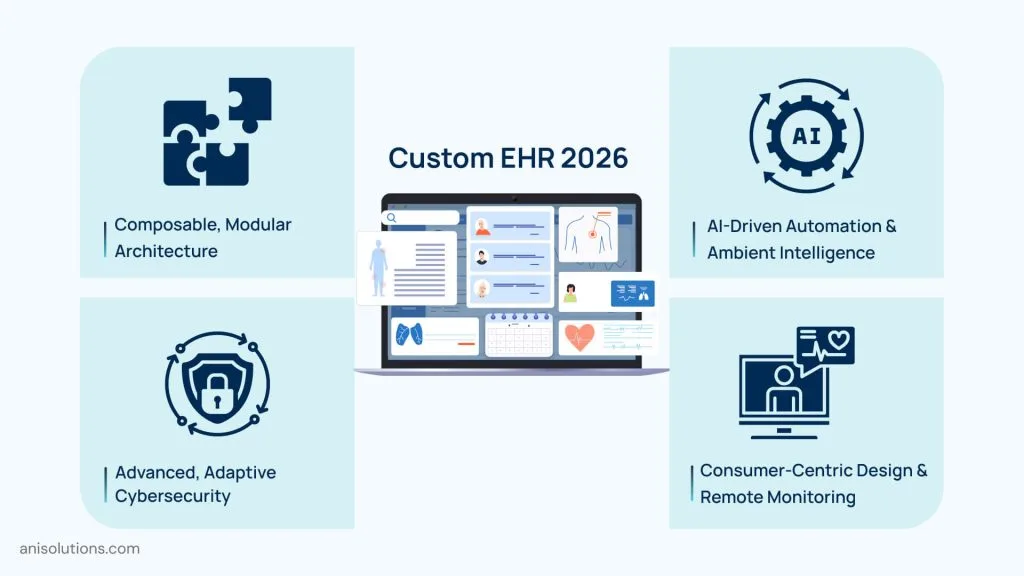
Personalized EHR solutions in 2026 are being shaped less by vendor roadmaps and more by real-world pressure—clinical burnout, data overload, security threats, and rising patient expectations. The trends below reflect where customization is actually heading, not just where it’s marketed.
- Composable, Modular EHR Architecture
Monolithic EHR systems are steadily giving way to composable architectures. Think Lego blocks instead of concrete slabs. Organizations can plug in, replace, or upgrade individual modules—clinical documentation, billing, analytics, or patient engagement—without rebuilding the entire system. This modular approach makes it easier to adapt as care models evolve, regulations shift, or new technologies emerge.
- AI-Driven Automation & Ambient Intelligence
AI in 2026 isn’t about flashy features—it’s about getting out of the clinician’s way. Tailored EHRs increasingly use AI to reduce manual data entry through ambient documentation, smart summarization, and context-aware prompts.
More importantly, organizations are deploying custom AI agents tuned to specialty workflows and provider behavior. These agents assist with charting, follow-ups, and care coordination in ways that actually reflect how teams work day to day.
- Enhanced Cybersecurity Driven by Real-World Breaches
Recent breaches have made it clear that baseline HIPAA compliance isn’t enough. That’s why, when you personalize an EHR, you adopt adaptive, organization-specific security models—role-based access, behavioral monitoring, and continuous audit readiness—designed around real operational risks, not generic checklists.
- Consumer-Centric Design & Remote Monitoring Integration
Patients now expect healthcare technology to feel intuitive. And tailored EHRs are responding with consumer-grade interfaces and deeper integration with remote patient monitoring. Specialized dashboards pull in wearable and disease-specific RPM data, giving care teams actionable insights without drowning them in raw metrics.
Benefits of EHR Software Built for Your Practice
When it comes to the benefits of EHR customization, they are operational, clinical, and strategic. Moreover, clinics are customizing and personalizing their EHR to keep up with the rapid advancement in healthcare technology, without burning out their teams.
So, when your EHR is designed around real workflows, the impact is quite tremendous across efficiency, care quality, and long-term adaptability. Here is a snapshot of the benefits an EHR that fits how your practice brings to your clinic:
| Benefit Area | How EHR customization Delivers Value |
| Operational Efficiency & Reduced Burnout | Workflow-matched screens reduce clicks, eliminate duplicate data entry, and speed up charting—freeing clinicians to focus on patients instead of screens. |
| Future-Ready & Competitive Advantage | Custom systems adapt faster to regulatory updates, new care models, and emerging technologies without waiting on vendor roadmaps. |
| Greater Control Over System Evolution | Organizations decide what gets built, updated, or retired—avoiding forced upgrades or unused features. |
| Improved Patient Care Quality | Specialty-specific workflows and decision support align documentation, orders, and follow-ups with clinical best practices. |
| Smarter Data & Insights | Analytics and automation are tailored to population needs, producing insights that are actually actionable. |
Why Healthcare Providers Choose EHR customization Over Off-the-Shelf Software
Click Here For Detailed BreakdownFinal Thoughts: Personalized EHR as the Healthcare Technology
In a nutshell, a personalized EHR is not just a tech upgrade for the generic systems— it’s a complete revamp of how an EHR functions. By building the EHR around your workflows, you eliminate the gaps and streamline every process and operation.
So, if you are having issues with developing a compatible and evolving EHR, then stay tuned. You can also talk to our EHR experts to develop your own EHR software development roadmap.
Frequently Asked Questions
An off-the-shelf EHR forces standardized workflows on every practice. A modern custom EHR is built around how your clinicians, staff, and specialties actually work—eliminating workarounds, reducing friction, and improving efficiency from day one.
Customization itself doesn’t create risk. In fact, a properly built custom EHR can be more HIPAA-compliant than generic systems by embedding role-based access, audit trails, and security controls directly into real workflows.
In 2026, key differentiators include modular architecture, AI-assisted documentation, specialty-specific workflows, advanced interoperability, configurable analytics, and automation designed around care delivery—not just data storage.
Most medium-sized specialty clinics see development and phased implementation within 6 to 12 months, depending on complexity, integrations, and regulatory requirements. Modular builds and agile rollouts help accelerate time to value.
AI-driven automation, composable modular architecture, and workflow-specific interoperability deliver the strongest ROI by reducing clinician burnout, minimizing manual work, and allowing systems to evolve without costly full-platform replacements.
Yes. Modern customizable EHR modules are designed to integrate with legacy billing platforms, lab equipment, and third-party tools through tailored APIs, middleware, and non-standard data connectors—without disrupting existing operations.
Custom EHR development typically requires higher upfront investment but avoids escalating licensing fees. Over time, many organizations find custom systems more cost-effective due to lower per-user costs and greater control over enhancements.
A&I Solutions
Continue the conversation
Explore more blog or contact our team about your goals.